
Teaching Online Card Games to Friends Who Have Never Played
By eggverse · · 4 min read

Teach a new online card game by explaining its goal, showing one legal action, demonstrating a mistake and playing an agreed practice round. Link the actual rules and controls. A newcomer should know what to press and what to watch before the clock or a challenge window starts.
Start with four questions
- What am I trying to do?
- Which control makes my main move?
- What should I watch in the middle?
- What happens when I make a mistake or fold?
Answer these for one game at a time. Speed, Spoons, The Yolk’s On You and Texas Hold’em use different actions and different information. “You’ll get it once we start” leaves the first mistake to teach the interface.
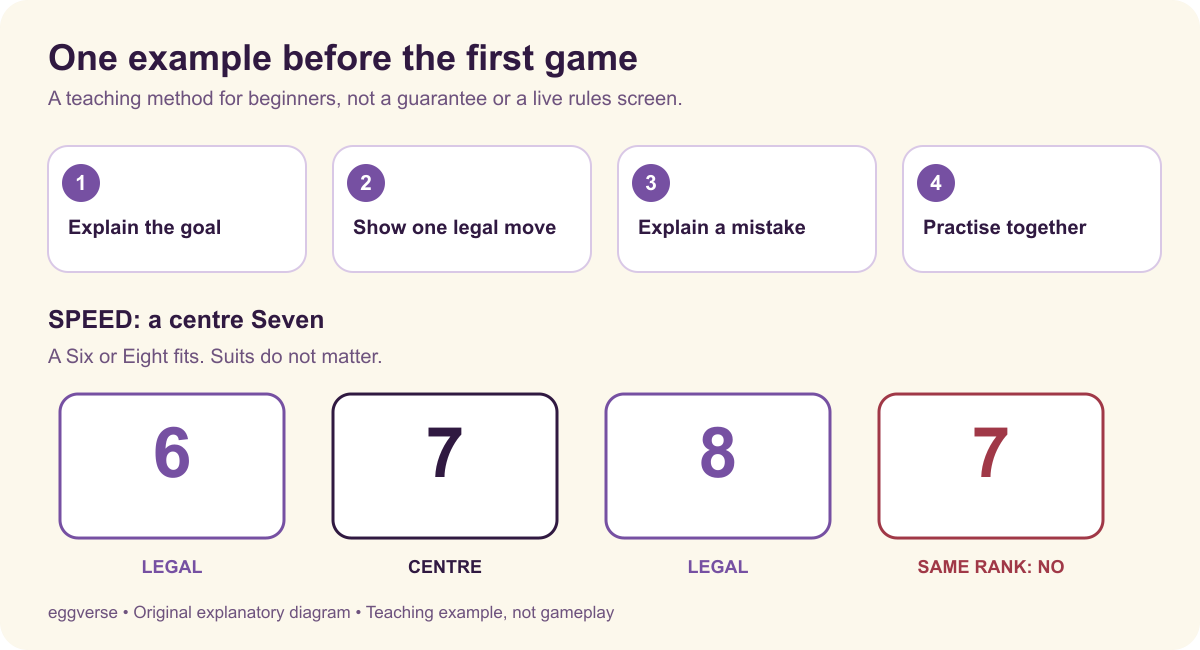
Show one concrete move
| Game | One action to demonstrate | A mistake or consequence |
|---|---|---|
| Speed | Play a Six or Eight on a centre Seven, regardless of suit | Another Seven does not fit. Watch both centre piles because a rival can change them. |
| The Yolk’s On You | When Sixes is offered, select a Six and Queen, then claim “2 Sixes” | A challenge reveals one wrong rank, so the claim is false and the claimant takes the whole pile. |
| Spoons | Collect four cards of the same rank, then make the first grab | A premature grab without four matching cards eliminates you. Missing a spoon also eliminates you. |
| Texas Hold’em | Use your two private cards and the shared community cards; demonstrate check, call, raise and fold | Check is available only with no bet to match. Folding ends that hand for you. |
For Speed, stop after the centre Seven example before adding faster scanning tips. The hand refills from your stack, and the goal is to clear all twenty cards. Both players act at the same time. Aces connect to Kings and Twos; matching ranks are not legal placements.
For The Yolk’s On You, the claim is what you are calling the selected cards, not a promise that they all have that rank. Show the BLUFF ? button and its three second window: shouting an accusation on a voice call does not submit a challenge. If nobody challenges in time, the cards stay hidden and play continues.
For Spoons, separate the first grab from the rush that follows it. Someone must first have four matching ranks. Once that player grabs, the others can try for a remaining spoon. Show where the spoon control is in the real game instead of inventing a gesture.
For Hold’em, show where private and community cards appear before explaining betting. Check is available when no chips are due; call matches the amount due, raise increases it and fold leaves the hand. eggverse uses free table chips. Teach those choices before discussing tactics or hand strength.
- Speed rules and controls, View game
- Cheat rules and challenges, View game
- Spoons rules and elimination, View game
- Hold’em rules and betting controls, View game
Agree on a practice round before starting
Tell everyone the first game is for learning. Give them time to find their controls before readying up. Afterwards, ask the newcomer to explain one rule in their own words. If it is unclear, show the example again; losing a round is not evidence that someone understood it.
Casual does not mean untimed. Speed is simultaneous, Spoons is a reaction game, and Cheat’s challenge window is three seconds. On Couch Play, The Yolk’s On You announces the claim on the shared screen while each phone keeps its cards private. Regular play uses the same claim quantities and actions, with each person viewing their own screen.
Make the invitation part of the lesson
Choose the game before sharing a friends invitation. Speed is for two humans; Spoons, The Yolk’s On You and Texas Hold’em support two to eight. Newcomers can open the invite link or use Join a room. EGG- is already filled in, leaving only five digits to type. Check names in the lobby before starting.
Let people choose their next pace
Ask whether the pace felt comfortable, not just whether they won. Someone who dislikes quick input might prefer the turn by turn Royal Shells chess game, if chess interests them. Someone who dislikes betting terminology might prefer Spoons or Cheat. Let people change activities or take a break.
Should I reveal everyone’s cards while teaching?
Use an explanation or an agreed demonstration outside a competitive hand. Revealing private cards during active play changes the information opponents have.
How long do beginners have to call bluff in Cheat?
Three seconds. Tap BLUFF ? to call bluff; a spoken accusation does not submit an action.
Can a practice round guarantee everyone will feel comfortable?
No. It is an introduction, not a guarantee. Explain again, change games or offer a break when someone needs it.
Which games suit different group sizes?
Speed and Royal Shells are for two humans. Spoons, The Yolk’s On You and Texas Hold’em support two to eight in regular friends rooms.