
How chess pieces move: a beginner’s guide to every piece and rule
By EggVerse · · 6 min read

In chess, the king moves one square in any direction, the queen moves any distance in a straight line or diagonal, the rook moves any distance along a row or column, the bishop moves any distance diagonally, the knight jumps in an L shape, and the pawn moves forward one square (two on its first move) but captures diagonally. That covers almost every move you will ever make. The rest of this guide explains the few special rules that confuse beginners and how a game actually ends.
Setting up the board
Turn the board so each player has a light square in the bottom right corner. Rooks go in the corners, then knights, then bishops. The queen goes on the square of her own colour, so the white queen starts on a light square and the black queen on a dark one. The king takes the last square on that row. Every pawn lines up on the row in front. White always moves first, and then the players alternate one move at a time.
Each piece at a glance
| Piece | How it moves | Worth remembering |
|---|---|---|
| King | One square in any direction | Can never move onto a square where it would be attacked |
| Queen | Any number of squares in a straight line or diagonal | The most powerful piece; it cannot jump over others |
| Rook | Any number of squares along a row or column | Two rooks working together are very strong late in a game |
| Bishop | Any number of squares diagonally | Each bishop stays on its starting colour all game |
| Knight | Two squares one way, then one square at a right angle | The only piece that jumps over others |
| Pawn | Forward one square, or two from its starting square | Captures one square diagonally forward and never moves backward |
Every piece except the pawn captures the same way it moves: it lands on an enemy piece and removes it. Nothing can capture its own side’s pieces, and only the knight can pass over anything in its way.
The three special moves
Castling. Once per game, you can move your king two squares toward one of your rooks, and that rook hops to the square on the king’s other side. You may castle only if neither the king nor that rook has moved yet, every square between them is empty, your king is not in check, and the king does not pass through or land on an attacked square. Castling tucks the king away and brings a rook toward the centre in a single turn.
En passant. If an enemy pawn moves two squares forward and lands right beside one of your pawns, your pawn may capture it as though it had moved only one square. You move diagonally onto the square it skipped, and the enemy pawn is removed. You must do this on your very next move, or the chance is gone. It only ever applies pawn to pawn.
Promotion. A pawn that reaches the far side of the board must become a queen, rook, bishop or knight of the same colour. Most players choose a queen, and you may have more than one. Picking a knight now and then is legal and sometimes delivers a surprise check.
Check, checkmate and stalemate
- Check: your king is under attack. You must get out of check on your next move by moving the king, blocking the attack or capturing the attacking piece.
- Checkmate: your king is in check and no legal move gets it out. The game ends and the other player wins. Kings are never actually captured.
- Stalemate: it is your turn, you are not in check, and you have no legal move at all. The game is a draw, which is why a player who is far ahead must leave the losing king some room.
Games can also be drawn when the same position appears three times with the same player to move, when neither side has enough pieces left to force checkmate (a lone king against king and bishop, for example), or when fifty moves by each player pass with no capture and no pawn move. Players can also simply agree to a draw.
Beginner mistakes worth avoiding
- Moving the same piece over and over in the opening. Bring out knights and bishops first, then castle.
- Bringing the queen out very early, where it gets chased around while the other side develops.
- Forgetting that pawns cannot capture straight ahead, or move straight ahead when a piece blocks them.
- Missing that your move left a piece undefended. Before you let go, ask what your opponent can capture next.
Practise the moves on a free board: Royal Shells
Reading rules only goes so far. On EggVerse, chess is called Royal Shells: classic chess with egg shaped pieces and no clock. Tap or click a piece and its legal squares glow, so you can see exactly where a knight or bishop is allowed to go before you commit. On a keyboard, the arrow keys move focus, Enter selects and Esc clears your choice.
The game follows the full rules in this guide. Castling and en passant work under the normal conditions, a pawn on the far rank lets you choose a queen, rook, bishop or knight, and the game recognises checkmate, stalemate, threefold repetition, insufficient material and the fifty move rule. A Royal extras panel in the game restates the special moves if you forget them mid match.
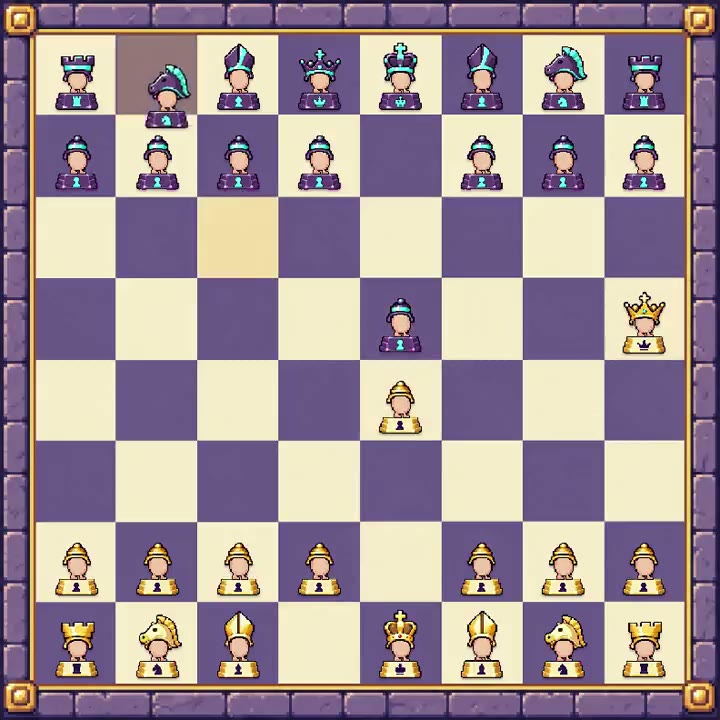
- Against the computer: choose Gentle, Thoughtful or Scheming. Take back a turn lets you undo and try another idea, which is useful while you learn.
- Two people, one device: pass and play on one phone, tablet or computer, and flip the board when you hand it over.
- Two devices: create a room, send the invitation, and play a friend online. Each player moves on their own screen, and either of you can offer a draw.
There is no timer in any mode, so a new player can stop and count squares without being rushed. It runs free in the browser with nothing to install.
Questions beginners ask
Can a king capture a piece?
Yes, as long as the piece is not protected. The king can never move onto a square that another enemy piece attacks.
Can a pawn move backward?
No. Pawns only ever move forward. Once promoted, the new piece moves normally, including backward.
Can you castle out of check?
No. You cannot castle while in check, through an attacked square, or into check. You can castle later once the check is gone, if the king and rook still have not moved.
Is stalemate a win?
No. Under standard rules, stalemate is a draw, even if one side has far more pieces.
Learning with someone else? Our Royal Shells guide covers its three modes in more detail, and the two player games page lists what else you can play as a pair.