
Brick breaker tips: aim with the paddle, use power ups, finish the wall
By EggVerse · · 6 min read
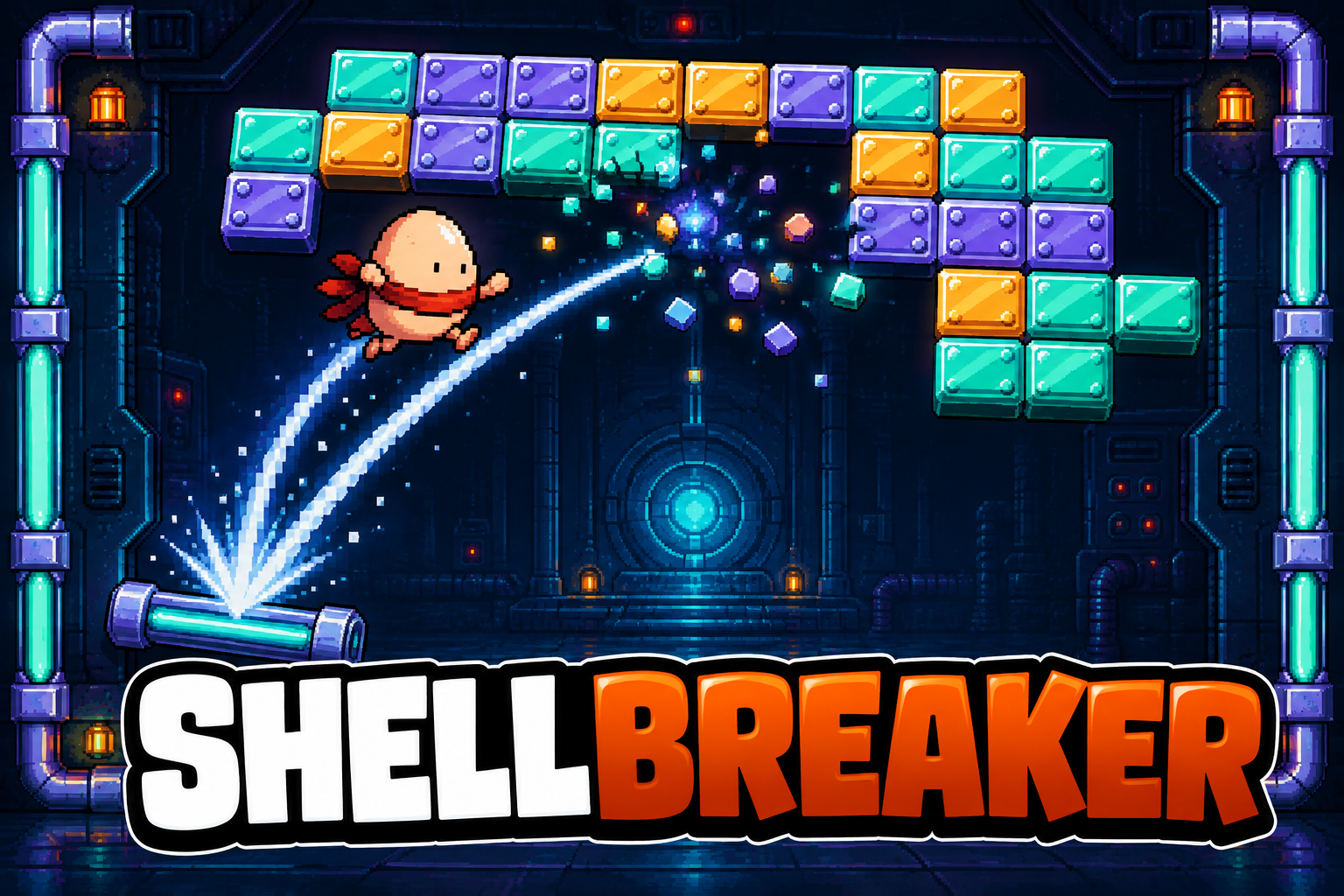
The most useful brick breaker tip is that you aim with the paddle, not the ball. In most Breakout style games, the spot where the ball lands on the paddle sets the angle it leaves at: the middle sends it almost straight up, the edges send it off at a sharp slant. Once you start choosing which part of the paddle to use, you stop reacting and start placing shots.
How brick breaker games work
A wall of bricks fills the top of the screen and a paddle slides along the bottom. The ball bounces off the side walls, the ceiling and your paddle, and every brick it touches breaks or takes a hit. Clear every brick to finish the level. Let the ball fall past the paddle and you lose a life.
Atari’s Breakout, from 1976, set the pattern. Arkanoid, released by Taito in 1986, made falling power up capsules part of the genre. Most brick breakers since mix the same ingredients: bricks that need more than one hit, levels that speed up, and pickups that change the ball or the paddle. The details differ from game to game, but the tips below carry over.
Control the angle
- Use the edges on purpose. A ball off the left side of the paddle heads left, and off the right side it heads right. Save the centre for a slower, straighter return you can track easily.
- Move into the ball. In many brick breakers, a paddle that is still sliding when the ball lands adds extra sideways speed in that direction. It is a second way to bend a shot.
- Watch where the ball will land, not where it is. After it leaves a wall, glance at its direction and get the paddle there early. Arriving early is what lets you pick an edge instead of lunging.
- Avoid very flat angles. A ball that crawls sideways spends a long time away from the bricks and is hard to read when it finally drops.
Use power ups without losing the ball
Power ups usually drop out of broken bricks and drift down, so catching one means moving under it. That is the trap. Chasing a pickup on one side while the ball comes down on the other is one of the most common ways to lose a life. Go for a pickup only when the ball is high and still rising.
The usual types are multiball, a wider paddle, a slower ball, lasers or a sticky paddle, and a safety net along the bottom. Multiball pays off most while the wall is still thick, because every extra ball is breaking something. A safety net helps most late in a level, when one miss would cost you the bricks you have already cleared.
Clearing the last few bricks
Every brick breaker has the same ending problem: two or three bricks left in a corner, and the ball keeps sailing past them. A few ways through:
- Tunnel behind the wall. Break a column open near one side, send the ball up through the gap, and it bounces between the top of the wall and the ceiling, breaking bricks from above while you wait.
- Break the pattern. If the ball keeps tracing the same path, it will keep missing. Take the next return off the opposite edge of the paddle.
- Bank off the side walls. A steep shot into a side wall reaches corners that a straight shot cannot.
- Play safe returns until one lines up. Late in a level the ball is often at its fastest, and a rushed swing costs more than a patient one.
Try it online: Shellbreaker
To practise these tips in your browser, Shellbreaker is a free brick breaker on EggVerse. You bounce an egg instead of a ball into a field of grassy bricks. Slide the paddle with the arrow keys or A and D, and press Space to launch. On a phone, tilt or drag the paddle and tap Launch.
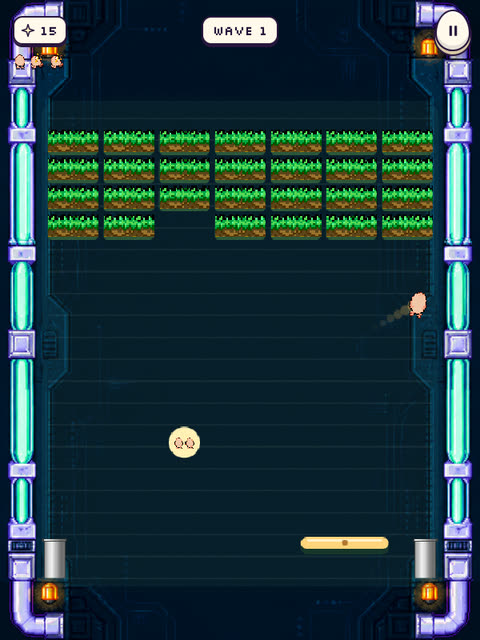
Solo, Shellbreaker is a run of waves. Clear the field and a new wave starts with more rows, up to six. From the second wave the top rows take two hits, and later waves leave gaps inside the wall, so the tunnel trick works here too. Chain brick hits without touching the paddle and your score multiplier climbs, up to six times. You get one shell per run: when the last egg falls, the run is over.
Two power ups fall from broken bricks. Multi Egg splits your egg into more, with up to four in play at once. Shell Shield raises a safety floor for 16 seconds that bounces falling eggs back up; each rescue uses up some of its time. The paddle edges do exactly what this guide describes, and a moving paddle adds a little extra sideways push.
Two paddles, one wall
Shellbreaker is also built for two players. Create a friends room, share the invite link, and your friend joins with a paddle of their own. Each of you guards one half of the bottom of the field. You share one brick field and one egg life, so it is fully cooperative: if the rally dies, it dies for both of you. You have two and a half minutes to clear three waves, and the serve passes between you after each wave. A Shell Shield either of you catches protects you both.
The tricky spot is the middle, where your two halves meet. Shared rallies tend to die there because each player expects the other to take it. Agree that whoever is closer takes the egg, and use your paddle edge to send returns toward the side of the wall that still needs work.
Quick answers
Where should the ball hit the paddle?
Off centre, toward the side you want it to go. The centre gives a near vertical return, and the edges give the sharpest angles.
Why can I never hit the last brick?
The ball is probably repeating the same path. Return it off the other edge of the paddle, or open a gap at the side and let it bounce along the top of the wall.
Should I always grab power ups?
No. Move for one only when the ball is safely on its way up. Losing the ball costs more than missing a pickup.
Is there a two player brick breaker online?
Yes. Shellbreaker on EggVerse gives each player a paddle on one shared brick field. It is free in the browser on phones, tablets and computers.
Looking for more games for a pair? Browse the two player games or the co op games.