
Chess Blunder Checklist: Three Questions Before Every Move
By EggVerse · · 5 min read

Before making a chess move, ask three questions: what did the opponent's last move threaten, can the piece I am moving be captured on its new square, and what will I stop protecting when I move it? This short check will not calculate every tactic, but it gives beginners a repeatable way to catch avoidable oversights.
You can use it on a physical board or in Royal Shells, EggVerse's chess game. The aim is to understand a move before making it, wherever you play.
1. What changed after the opponent moved?
Begin with the opponent's idea before returning to your own. A move can attack a piece, open a line or create a threat somewhere else on the board. If you keep following the plan you made several turns ago, you can miss the new situation in front of you.
Find your king first. If it is in check, the next move must deal with that check; leaving your king under attack is illegal. The basic rule is stated in the FIDE Laws of Chess.
Then examine your other pieces. Ask which one is newly attacked and whether a capture would matter. Do not assume every threat requires retreat: a piece may be defended, or you may have a stronger reply. The checklist asks you to notice the threat before deciding, not to run away from every attack.
2. What can capture my piece on the new square?
Picture your proposed move as though you have already made it. Look from the destination back toward the opponent's pieces. Which ones could reach that square? Are any lines blocked now but opened by your move?
This is particularly useful before taking something that appears free. A capture can remove a blocker and expose the capturing piece to a rook, bishop or queen behind it. The first capture is only the beginning of the exchange.
You do not need a long calculation for every beginner position. Start with the opponent's most direct response. If you cannot explain what happens after that reply, pause before committing to the attractive move.
3. What do I leave behind?
A piece has two locations to consider: the square it reaches and the square it leaves. It may currently be defending another piece or blocking a line toward your king.
Moving it can change the position even if its destination is safe. Ask what was protected by its old position and whether another piece will still do that job. This is the question that a destination only check misses.
Worked example: a bishop line to the king
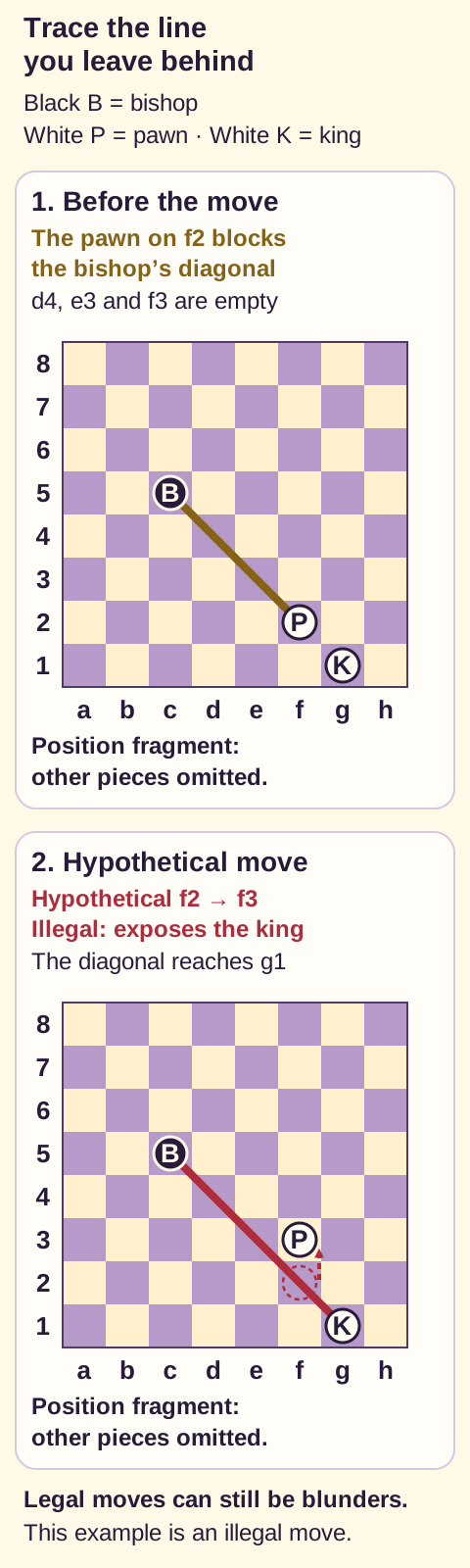
Consider this simplified position fragment: your white king is on g1, a white pawn is on f2, and a black bishop is on c5. The diagonal from c5 toward g1 runs through d4, e3 and f2. Assume d4, e3 and f3 are empty.
The pawn on f2 is currently blocking the bishop's line. If you consider advancing that pawn to f3, ask the third question: what do I leave behind? Removing it from f2 would expose the king to the bishop, so that move is illegal in this position. Bishops move diagonally and cannot pass through intervening pieces; see the basic movement rules.
This is a legality example. Even when a game highlights legal moves, those moves can still be blunders: a legal move may lose a piece or overlook a threat. The three questions help you look beyond whether a move is allowed.
The purpose of the example is not to memorize those squares. It is to trace what changes when a piece leaves its job. Other pieces elsewhere on a complete board can add more considerations, but they do not remove this exposed line in the stated fragment.
A small worksheet for your next game
Use the following prompts for three consecutive turns. Three is a practice suggestion, not a chess rule.
| Prompt | Your note before moving |
|---|---|
| Opponent's last move | “It changed…” |
| My candidate move | “I want to do this because…” |
| Their direct reply | “They could respond by…” |
| What I leave behind | “This square, line or piece loses…” |
Keep notes brief. The exercise is meant to make you look, not to turn a casual game into paperwork. If you are playing a friendly teaching game, agree beforehand whether both players want to discuss their thinking aloud.
Review the missed question
After a blunder, identify which part of the check you skipped. Did you ignore the latest threat, place a piece where it could be captured, or remove a defender without noticing? That gives the next game a practical focus.
Try the routine in Royal Shells or during a friendly game on a physical board. A better move begins with a clearer view of the position, and three consistent questions can help you build that habit one turn at a time.
Questions about the checklist
What should I check before making a chess move?
Check what the opponent’s last move changed, what could capture your piece on its destination, and what you stop defending or blocking when you move it.
Can a legal chess move still be a blunder?
Yes. A move can obey the rules but lose a piece or overlook a threat. The checklist asks whether the move makes sense, as well as whether it is allowed.
Why is f2–f3 illegal in the bishop example?
With d4 and e3 empty, the white pawn on f2 blocks the black bishop on c5 from attacking the white king on g1. Moving the pawn to f3 opens that diagonal and exposes the king. The diagram is a position fragment, not a complete game.